
The problem with "I'll take a break later"
Most busy people do not skip breaks on purpose. They skip them because stopping feels harder than pushing through. One more email. One more Slack thread. Then it is 4 pm and your neck is on fire.
The irony is that the break would have saved more time than it cost. Attention does not hold for eight straight hours. Posture does not either. The body quietly files complaints, and by evening the inbox is clear but you are a mess.
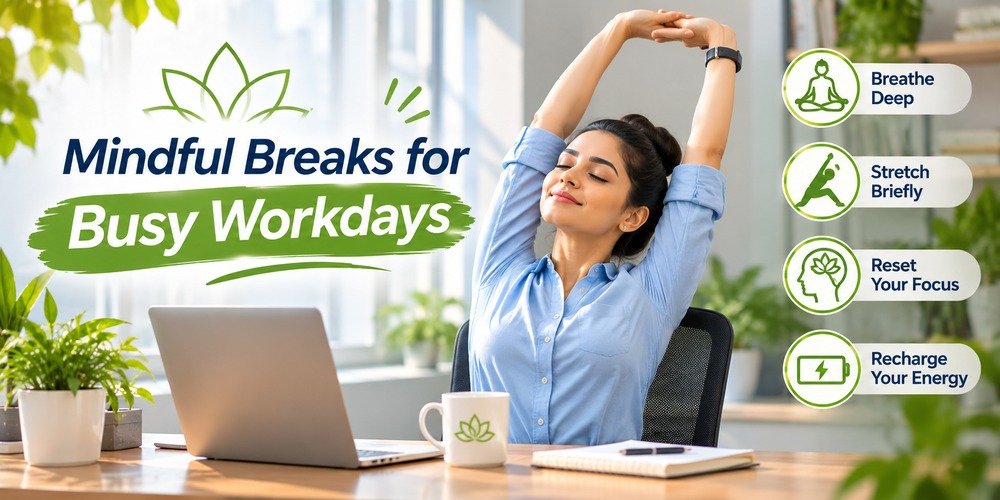
A mindful break is not a yoga class at your desk. You do not need a mat, a timer, or anyone around you to notice. Two minutes, a quiet breath, and a small reset of the body is enough.
What a mindful break is (and is not)
A mindful break is any short pause where you move your attention away from the screen, bring it into your body, and let your breath slow down.
It is not a scroll break. It is not a coffee break with your phone. It is not "checking one more thing" and calling it rest. If your brain is still working during the pause, it is not a break. It is a context switch.
The point is simple. Get out of your head for a minute. Feel what is happening in your body. Go back to work as a steadier version of yourself.
Six breaks you can take today.
The two-minute reset (anytime)
Sit tall or stand up. Let your shoulders drop. Inhale slowly through your nose and lengthen through the spine. Exhale through the nose and soften your jaw, your shoulders, your belly. Repeat for 5 to 8 calm breaths. That is the whole thing.
Neck and shoulder release (after an hour at the screen)
Drop your chin toward your chest. Let gravity do the work for 3 breaths. Lift your head. Tilt your right ear toward your right shoulder. Rest there for 3 breaths. Then the left. Roll your shoulders back three times. You will feel a few inches taller when you look up.
Standing fold (before a tough meeting)
Stand up. Feet hip-width apart. Fold forward from the hips with soft knees. Let your head and arms hang. Breathe into your lower back for 5 breaths. Roll up slowly. This moves blood, clears a foggy head, and takes under a minute.
Wrist and finger stretch (for the keyboard shift)
Extend your right arm forward, palm up. With your left hand, gently pull your right fingers toward the floor. Hold for 5 breaths. Switch sides. Then make loose fists and open them a few times. Your wrists will thank you by Friday.
Eye reset (every hour)
Look away from the screen. Find something at least six metres away. Soften your gaze for 20 seconds. Close your eyes for 10. Open and blink a few times. This is the 20-20-20 rule your optometrist mentioned. It works.
Legs and lungs (lunchtime)
Take a short walk outside, even five minutes. No earbuds. No phone. Notice three things you can see, two you can hear, one you can smell. Breathe deeper than usual. Come back and you will be measurably sharper than when you left.
Making this actually happen
Nobody follows a wellness plan from willpower alone. The breaks that stick are the ones that already live inside your day.
A few ways to anchor them:
- Pair a break with something you already do. One breath reset after every meeting. A neck release after every coffee. A fold before every one-on-one call.
- Put a sticky note on your monitor with the two-minute reset. The reminder is the hard part, not the practice.
- Block one lunch walk per week to start. Not every day. One.
- Share the practice with a colleague. A 90-second group reset before a big meeting is not weird. It is a gift.
If any of this feels like one more thing on your list, start smaller. One breath. One stretch. Once a day. Small wins change what you expect from yourself.
When you want more structure
If you would like personal guidance, Yogability can help you build a practice that fits your life, your job, and your body. Kiran works with individuals and teams across Burnaby and online, including short corporate wellness sessions that drop neatly into a workday.